


How to Write a Profitable Tanning Salon Business Plan for 2026
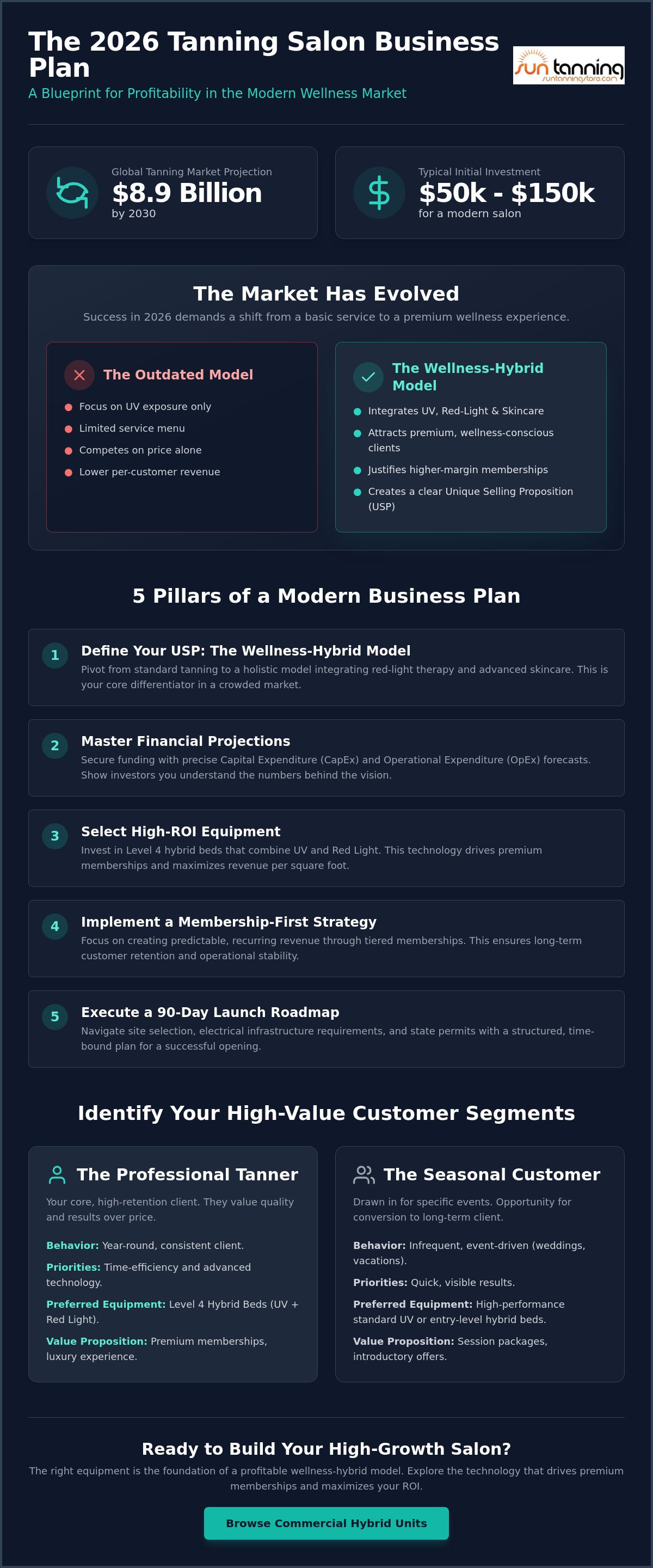
Could your current vision for a tanning salon survive a market that demands more than just UV exposure? While the global tanning market is projected to reach $8.9 billion by 2030, the path to profitability has shifted toward multi-functional service menus. Success in this industry now requires a sophisticated tanning salon business plan that balances traditional UV services with high-margin wellness technology. It's a pragmatic necessity for anyone looking to secure serious capital in 2026.
You're likely concerned about the $50,000 to $150,000 initial investment or the complexities of state-level regulations following recent FDA updates. We understand the pressure to differentiate in a competitive local market. This guide will show you how to master the essential components of a modern business plan to secure funding and ensure long-term operational success. We'll explore the specific ROI on commercial equipment, including hybrid red light units, and provide a clear strategy to outpace your competition through technical precision and superior service offerings.
Key Takeaways
- Identify your unique selling proposition by pivoting toward a Wellness-Hybrid model that integrates red-light therapy and advanced skincare technology.
- Master the financial components of a professional tanning salon business plan to secure funding through precise CapEx and OpEx projections.
- Evaluate the performance specifications and ROI potential of Level 4 hybrid beds to maximize per-customer revenue and premium membership value.
- Establish predictable recurring revenue using a membership-first pricing strategy designed for long-term customer retention and operational stability.
- Navigate the complexities of site selection and regulatory compliance with a structured 90-day roadmap focused on electrical infrastructure and state permits.
Defining Your Vision: The Executive Summary and Market Analysis
A successful tanning salon business plan starts with a clear, high-impact vision. It's not enough to offer standard UV beds anymore; your executive summary must articulate a shift toward a holistic wellness-hybrid model. In 2026, a compelling mission statement prioritizes skin health and technological efficiency. You need to define your 'Unique Selling Proposition' (USP) by focusing on performance-driven results that competitors likely overlook. This might include the integration of red-light therapy or specialized Level 4 hybrid equipment that offers shorter, more effective sessions.
Conducting a granular local demographic audit is your next priority. You aren't just looking for "people who want to be tan." You're looking for high-value segments willing to pay a premium for advanced skincare technology. To see how professional studios appeal to this demographic through high-end facial services, discover Skin Care Pro Group. Analyze your local competitors to identify specific service gaps. If the three nearest salons only offer traditional UV, your gap is clear: red-light and hybrid options. This strategic positioning ensures your brand doesn't just enter the market; it leads it. It's about finding the "white space" where demand for modern wellness intersects with outdated local supply.
The 2026 Tanning Market Landscape
The industry is evolving rapidly. According to this Indoor Tanning Industry Overview, the sector has moved far beyond its origins. The global market is projected to reach $8.9 billion by 2030, driven largely by technological advancements. Hybrid tanning technology, which combines UV and Red Light, is now a national standard for new, high-growth salons. Today's 'wellness-conscious' tanner views their session as part of a broader self-care routine. They value the collagen-stimulating benefits of red light as much as the aesthetic bronze of UV. Red-light therapy units are no longer optional "add-ons"; they are essential for capturing the modern market share and justifying premium membership tiers.
Identifying Your Target Demographic
Precision matters when defining your audience. You must distinguish between the 'Professional Tanner' and the 'Seasonal Event' customer. Professional tanners are year-round clients who prioritize consistency and advanced equipment like Level 4 hybrid beds. They typically fall into a higher income bracket and value time-efficiency. Mapping these specific customer pain points to your offerings ensures your marketing hits the mark. If your local audit reveals a high concentration of young professionals, your tanning salon business plan should emphasize speed, luxury, and the latest wellness tech. These trend-conscious clients often value exclusivity in all aspects of their lifestyle, whether they are sourcing high-end footwear from Lab X Supply or seeking the most advanced tanning technology in your studio.
Operational Strategy: Selecting High-Performance Equipment
Your operational strategy revolves around the hardware that drives your revenue. In a 2026 tanning salon business plan, equipment selection isn't just about filling rooms; it's about matching technical specifications to your target demographic's expectations. While standard UV beds provide a foundation, the shift toward wellness-centric services requires a mix of hybrid and red-light therapy units to remain competitive. You should consult the SBA Business Plan Guide to ensure your operational costs for these units are documented correctly for potential lenders.
Reliability is non-negotiable. Purchasing through authorized national distributors ensures you receive valid warranties and professional technical support, which are critical for maintaining high uptime. Integrating low-overhead revenue streams, such as spray tanning start-up kits or high-tech beauty services, allows you to diversify without significant additional square footage. For instance, you can learn more about LivBay Lash Supplies to see how UV lash technology can complement your salon's technical offerings. Superior equipment quality remains the primary predictor of salon retention because clients prioritize tangible results and session comfort over any other operational factor.
The Hybrid Advantage: UV + Red Light
Hybrid technology represents the premium tier of modern indoor tanning. Units like the ProSun Jade 32 120v Hybrid Red Light Tanning Bed attract skincare-focused clients who might otherwise avoid traditional UV-only salons. By positioning hybrid technology as a high-end service, you can justify higher per-session pricing and more expensive membership tiers. This isn't just a trend; it's a pragmatic response to a market that values skin health alongside cosmetic results. If you're looking to upgrade your fleet, you can browse commercial hybrid units to see current performance specifications.
Commercial Equipment Packages for Scalability
Scaling your business efficiently requires a strategic balance between entry-level and high-performance Level 4 tanning beds. High-pressure Level 4 units, such as the ProSun Onyx 12 Minute Level 4 Hybrid Commercial Tanning Bed, are essential for your top-tier membership packages. These units provide faster results and shorter session times, which improves room turnover and customer satisfaction. You can find more detail on balancing these assets in this guide to tanning salon equipment packages. Proper space planning is equally vital; you must ensure your layout maximizes equipment density while maintaining the electrical infrastructure and airflow necessary for high-output commercial beds.
Marketing and Customer Acquisition: Building a 2026 Brand
Predictable cash flow starts with memberships. In your tanning salon business plan, the marketing section shouldn't just list social media platforms; it needs to detail a membership-first pricing structure. This model creates a foundation of recurring revenue that sustains the business through seasonal fluctuations. By moving away from single-session sales, you secure a committed customer base that views your salon as a regular part of their wellness routine. It's a pragmatic shift from transactional retail to a service-based subscription model.
Leveraging social proof is essential for high-margin wellness services. Red-light therapy and hybrid tanning provide visible results that are perfect for 'before and after' marketing campaigns. High-quality imagery and client testimonials act as powerful validators for your technical offerings. When potential clients see real-world results from your Level 4 equipment, the barrier to entry drops significantly. Authority is built through verified results, not just slogans.
Membership Tiers and Recurring Revenue
Designing an exclusive 'Level 4' membership tier allows you to capitalize on the high-performance equipment discussed in your operational strategy. These memberships should offer unlimited access to premium units like the ProSun Onyx. You can also incorporate red-light therapy as a standalone membership or a high-value add-on for existing UV tanners. The psychology of 'unlimited' tanning often outperforms session-based packages. It removes the 'cost-per-visit' mental barrier, which encourages more frequent visits and increases opportunities for retail lotion sales.
Digital Marketing for Modern Salons
Local SEO is your most effective acquisition tool. Most new clients will find you by searching for 'tanning near me' on mobile devices. Your website must be optimized for local search and feature integrated booking tools to capture this traffic immediately. Social media content should focus on tanning safety and technical results rather than just lifestyle imagery. Incentivizing referrals and online reviews builds the local authority needed to outrank established competitors. Automated email marketing further supports this by sending targeted promotions and 'we miss you' offers during the off-peak winter months to reduce churn.
Financial Projections: CapEx, OpEx, and ROI Analysis
Financial precision is the difference between a thriving studio and a failed venture. Your tanning salon business plan must clearly differentiate between one-time capital expenditures (CapEx) and ongoing operating expenses (OpEx). CapEx involves your initial equipment fleet, leasehold improvements, and the specific electrical build-out required for high-draw commercial units. OpEx covers the monthly realities of labor, rent, and utility bills. Forecasting revenue requires a realistic look at membership uptake rates across your tiers. This ensures your cash flow remains positive even during the slower summer months when foot traffic typically dips.
Don't overlook the technical hidden costs. Lamp life cycles and acrylic degradation are predictable but often ignored in amateur business plans. You also need to account for the 10% federal excise tax on all UV tanning services, which is a non-negotiable regulatory cost. By documenting these details, you demonstrate a level of professional transparency that banks and investors demand. It shows you understand the pragmatic realities of the industry beyond just the aesthetic appeal of a new salon.
Startup Costs and Financing Options
Choosing your equipment mix is your most significant financial decision. You'll need to weigh the long-term ROI of a level 4 tanning bed against more affordable entry-level units. While high-performance beds represent a larger initial outlay, they command the premium membership fees that drive profitability. Financing through equipment leasing is a common strategy to preserve liquid capital for marketing and payroll. A structured 12-month cash flow forecast will help you identify exactly when your salon will reach the break-even point.
Maintaining Profitability Through Reliability
Reliability directly impacts your bottom line. Budgeting for tanning bed maintenance tips prevents expensive emergency repairs and keeps your rooms generating revenue. Regular lamp replacements are essential to maintain the bronzing results your clients pay for. Energy-efficient 120v technology, found in modern units like the ProSun Jade 32, can significantly lower your monthly utility overhead compared to older, high-draw systems. Professional-grade equipment is an investment in uptime and customer satisfaction.
Secure your salon’s future with reliable, high-performance hardware. Shop our commercial tanning bed collections to finalize your financial projections.
Implementation: The 90-Day Launch Roadmap
Execution is where your tanning salon business plan becomes a physical reality. The final 90 days before opening require a disciplined focus on technical milestones and regulatory compliance. Securing a location is only the first step; you must verify that the facility can handle the specific electrical infrastructure required for commercial-grade equipment. Many landlords aren't familiar with the high-draw needs of a professional salon, so you'll need to lead the conversation regarding panel capacity and dedicated circuits. This period is also the time to secure your state and local health department permits, which often involve rigorous inspections of your sanitation protocols and equipment safety features. Additionally, ensuring the building's structural health is paramount; for roof inspections or installing natural lighting features, SYNERGY ROOFING - ROOFING & SKYLIGHT SPECIALIST provides the professional commercial support needed for site preparation.
Hiring and training should happen concurrently with your build-out. Your staff must be proficient in equipment safety and the technical benefits of different tanning lotions to drive retail revenue from day one. While the physical space is being prepared, execute a pre-launch marketing campaign to build a waiting list of potential members. Use the local SEO and social proof strategies discussed earlier to create a sense of urgency and exclusivity. The critical path from lease signing to your first customer requires a synchronized effort between electrical certification, health department approval, and staff competency training.
Site Preparation and Electrical Compliance
Coordinating with licensed electricians is paramount for a smooth launch. You'll need to determine the specific mix of 220v and 120v requirements for your fleet. For instance, while larger beds may require 220v, some versatile units like the ProSun Jade 32 120v Hybrid Red Light Tanning Bed allow for easier integration into standard commercial spaces. HVAC requirements are equally critical; you must have a system capable of managing the significant heat output of multiple high-intensity rooms. Your layout should prioritize customer flow while complying with all health and safety codes regarding room size and ventilation.
The Grand Opening Strategy
A soft launch is a pragmatic way to test your equipment and staff performance under real-world conditions. Use this one-week window to refine your intake process and ensure your inventory of tanning lotions and sanitizers is organized for efficiency. Your grand opening event should then focus on converting your waiting list into recurring memberships through exclusive first-day incentives. Don't forget to stock essential replacement parts, such as tanning lamps and acrylics, to ensure you can maintain 100% uptime during your high-traffic opening month. Success at this stage is defined by technical reliability and a seamless customer experience.
Securing Your Competitive Advantage in 2026
Building a profitable salon requires a move away from legacy models toward a data-driven, wellness-hybrid approach. You've seen how success depends on precise market analysis, high-performance Level 4 equipment, and a membership structure that ensures predictable cash flow. By prioritizing technical reliability and skincare-focused results, you differentiate your brand from local competitors who remain stuck in traditional UV-only services. It's about combining performance with efficiency to maximize per-customer revenue.
A professional-grade tanning salon business plan is your roadmap to securing capital and managing long-term growth. We act as a reliable bridge between manufacturers and owners; we are an authorized distributor for major commercial brands with full national shipping and warranty support. Whether you're integrating specialized kits for spray tanning or advanced red light therapy units, we provide the hardware necessary for operational excellence. Explore Professional Tanning Salon Equipment Packages to finalize your launch strategy. Your vision for a modern, profitable studio is within reach with the right technical partner.
Frequently Asked Questions
How much does it cost to start a tanning salon in 2026?
Initial investment depends on your leasehold improvements and the specific equipment mix you select for your facility. Your local build-out costs, electrical requirements, and the scale of your initial fleet will dictate the final budget. It's essential to account for the 10% federal excise tax and initial inventory when finalizing your financial projections.
What is the average profit margin for a tanning salon?
Profitability is driven by recurring membership revenue and high-margin retail sales like lotions and sanitizers. Successful salons focus on minimizing downtime through regular maintenance and maximizing the lifetime value of each member. By diversifying with wellness services, you can stabilize cash flow during traditional off-peak seasons and improve your overall bottom line.
Do I need a special license to operate a tanning business?
Operating a salon requires compliance with state-level health regulations and FDA requirements for Class II medical devices. You must obtain specific business licenses and health department permits before opening your doors to the public. Additionally, all equipment must display the required black-box warning labels advising against use by minors to remain in legal compliance.
How many tanning beds should a new salon start with?
Most mid-sized salons launch with a strategic mix of five to eight units to ensure steady customer throughput. This typically includes a combination of entry-level beds, Level 4 performance units, and specialized wellness equipment like red light therapy units. Starting with this range allows you to manage customer flow while maintaining room for future scalability as your membership base grows.
Is red light therapy more profitable than traditional tanning?
Red light therapy often yields higher profit margins because it appeals to a broader, wellness-conscious demographic. While traditional UV tanning remains a core revenue driver, red light services justify premium membership tiers and high-value add-ons. Integrating this technology into your tanning salon business plan helps differentiate your brand from lower-tier competitors who only offer basic UV services.
How do I secure financing for commercial tanning equipment?
Financing for high-performance equipment is commonly secured through specialized equipment leasing or SBA-backed loans. Lenders look for a professional tanning salon business plan that demonstrates clear ROI and a realistic path to profitability. Maintaining a detailed 12-month cash flow forecast is critical for proving your business’s financial viability to potential investors or banks.
What are the most common reasons tanning salons fail?
Salons often fail due to insufficient working capital or a failure to differentiate their services in a saturated market. Overlooking the "hidden" costs of lamp and acrylic replacements can also lead to a rapid decline in service quality and customer trust. Success requires a proactive approach to equipment maintenance and a membership-first marketing strategy that ensures predictable recurring revenue.
How often do I need to replace tanning bed lamps in a commercial setting?
Commercial tanning lamps should be replaced according to their manufacturer-rated hours, which generally fall between 500 and 1,000 hours of operation. Using a salon management system to track session time ensures you replace lamps before performance drops. This consistency is vital for maintaining the bronzing results that drive customer retention and justify your membership pricing.