


Home vs. Commercial Hybrid Tanning Beds: Which is Right for You in 2026?
The most expensive commercial tanning unit in your showroom might actually be a liability if your electrical grid can't support it. Many buyers assume that "commercial" always equals "better," but the reality of choosing a home vs commercial hybrid tanning bed in 2026 is far more nuanced. You want professional results and the anti-aging benefits of 635nm red light therapy without the headache of a massive electrical overhaul. It's a common frustration. You're looking for that perfect balance between tanning intensity and skincare technology, yet technical jargon often gets in the way of a smart investment.
We understand the need for clarity when balancing performance with practical logistics. This guide simplifies the differences in power requirements, comparing standard 120v residential plugs against the dedicated 220v circuits required for high-volume level 4 systems. You'll discover the critical differences in session times, lamp longevity, and overall ROI for both personal and professional use. We'll break down how electronic ballasts and hybrid UV-red light systems impact your daily operation and skin health. By the end, you'll know exactly which hybrid model fits your specific space and performance goals.
Key Takeaways
- Understand how the fusion of UV rays and 635nm red light prepares the skin through increased oxygenation for more efficient tanning results.
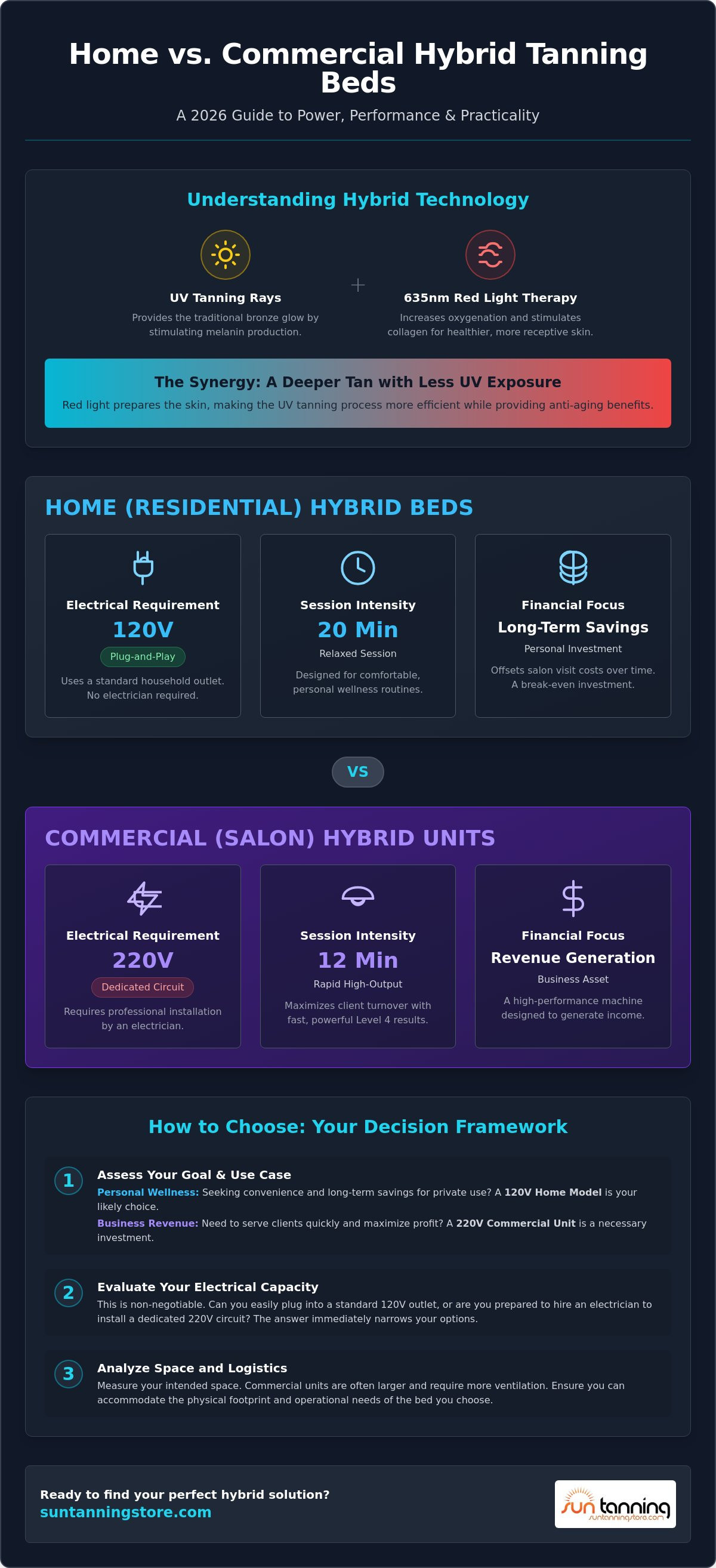
- Evaluate the logistical trade-offs of a home vs commercial hybrid tanning bed, specifically contrasting 120v "plug-and-play" convenience with the high-output efficiency of 220v dedicated circuits.
- Compare session intensity across equipment tiers, from the rapid 12-minute cycles of Level 4 commercial units to the relaxed 20-minute sessions of residential models.
- Identify your break-even point by analyzing the long-term savings of home ownership against the revenue-generating potential of professional hybrid services.
- Apply a structured decision framework to assess your physical space and electrical capacity before committing to a high-performance equipment investment.
Understanding Hybrid Technology: The Fusion of UV and Red Light
Hybrid tanning is the engineered, simultaneous delivery of UV rays and 635nm red light designed to maximize results while protecting the skin's integrity. It's a technical evolution. By integrating specialized Tanning lamp technology, these systems solve the primary drawback of traditional tanning: skin dehydration. This isn't just a trend; it's a fundamental shift in how we approach indoor tanning in 2026. These units function as multi-process wellness tools, delivering a bronze glow while actively working to improve the skin's overall texture and moisture retention.
The biological mechanism is direct and efficient. Red light triggers vasodilation, which increases blood flow and oxygenation at the skin's surface. Since oxygen is the primary catalyst for melanin production, the UV component of the session works with higher efficacy. You achieve a darker tan with less total UV exposure. Whether you're comparing a home vs commercial hybrid tanning bed for a salon or a personal fitness room, this synergy is the defining feature of modern equipment. It also helps eliminate the "tanning smell" often associated with older units by promoting better skin metabolism and reducing the thermal stress on surface bacteria during the session.
The Role of 635nm Red Light in Tanning
Specific wavelengths of red light do more than just warm the skin. At 635nm, the light penetrates the dermis to stimulate fibroblasts, which are the cells responsible for collagen and elastin production. This helps maintain skin elasticity even during UV exposure. Traditional beds often leave the skin feeling tight or leathery after a session. Hybrid systems mitigate this by maintaining moisture levels and reducing overall skin dryness. The 635nm wavelength represents the specific peak of red light required to activate skin cells for optimal UV receptivity. This biological priming ensures the skin is hydrated and receptive before the tanning process reaches its peak intensity.
Why Hybrid is Dominating the 2026 Market
The industry has moved past the era of pure tan at any cost. Consumers in 2026 demand wellness and skin health integrated into their beauty routines. This shift explains why hybrid beds are now the standard for high-end salons and luxury home setups. When comparing a red light therapy bed vs hybrid tanning bed, the hybrid model wins for those seeking a one-stop wellness experience. It satisfies the demand for multi-functional devices that offer anti-aging benefits and vitamin D synthesis in a single session. This evolution reflects a broader trend: people don't just want to look tan; they want their skin to look rejuvenated and healthy. Understanding the home vs commercial hybrid tanning bed landscape requires recognizing this shift toward comprehensive skincare as a non-negotiable standard.
Electrical Requirements: 120v Home Models vs. 220v Commercial Units
The logistical reality of a home vs commercial hybrid tanning bed often starts at your electrical panel. Residential models are engineered for accessibility, emphasizing a "Plug-and-Play" design that integrates into a standard household environment. In contrast, commercial systems are built for high-output performance and rapid turnover, which demands a more robust power supply. Understanding these technical thresholds is vital before you commit to an investment, as the wrong choice can lead to underperforming lamps or expensive, unexpected contractor fees.
For many home users, the appeal of a 120v system lies in its simplicity. You don't need to hire an electrician for a full-scale panel overhaul or run new industrial-grade conduit through your walls. However, if you're eyeing a professional-tier unit for a business or a high-performance home gym, the raw power of a 220v connection is often necessary to drive the intense UV and red light arrays required for shorter session times. All units, regardless of their voltage, must strictly adhere to FDA safety regulations for tanning beds to ensure consistent timer accuracy and output levels.
Residential 120v Hybrid Beds: Pros and Cons
Models like the ProSun Jade 32 120v Hybrid Red Light Tanning Bed are the gold standard for residential convenience. These units typically require a NEMA 5-20 outlet, which is a 20-amp, 120-volt connection common in modern garages or laundry rooms. The primary benefit is that you can begin your wellness routine immediately without structural modifications. The trade-off is session length. Because 120v systems have a lower power ceiling, sessions usually last 20 minutes to achieve the same results a commercial unit delivers in half that time. If you have the patience for a longer, more relaxed session, a 120v model is an efficient choice. You can browse our 120v hybrid inventory to find a model that fits your existing outlets.
Commercial 220v Systems: When is Rewiring Worth It?
When you transition to Level 4 or Level 5 equipment, a 220v or 240v dedicated circuit is mandatory. This higher voltage allows the bed to support a much higher lamp density and more aggressive cooling fans, which are essential for maintaining equipment health during back-to-back use. 220v electronic ballasts are significantly more efficient than older magnetic versions, often reducing energy consumption by up to 25% while providing a more stable current to the lamps. This electrical efficiency ensures that the increased power draw doesn't lead to unsustainable utility costs over time. While the initial setup requires a professional electrician, the result is a 12-minute session time and a faster return on your time or business investment. Choosing between a home vs commercial hybrid tanning bed ultimately depends on whether your priority is immediate "out of the box" use or long-term high-speed performance.
Performance Comparison: Session Intensity and Tanning Levels
Intensity is the primary differentiator when evaluating a home vs commercial hybrid tanning bed. While both systems utilize the science of red light therapy to prime the skin, the rate of pigment development varies significantly based on lamp pressure and density. Commercial units are built to deliver a base tan in fewer sessions by utilizing higher UVB ratios and more intense UVA output. This creates the Level 4 experience, which is characterized by deep, long-lasting color and a significant reduction in total time spent under the lamps. For a detailed breakdown of these technical specifications, see our Level 4 vs Level 5 Tanning Beds guide.
The concept of "Level 4" in a hybrid context refers to the equilibrium between maximum UV output and high-density red light therapy. In these professional systems, the lamps are often placed closer together or use higher wattages to ensure no "dead spots" in coverage. Home units are typically categorized as Level 2 or Level 3, providing a more gradual tan that is easier to manage for users who may not have professional-grade skin prep products on hand. Choosing the right level depends entirely on how quickly you want to see results and how much time you can dedicate to your weekly routine.
Session Efficiency: 12 Minutes vs. 20 Minutes
Time is a luxury. Professional units like the ProSun Onyx 12 Minute Level 4 Hybrid Commercial Tanning Bed use high-pressure lamps to condense the tanning process into a 12-minute window. You get a full session in nearly half the time of a residential model. Residential models usually require 20 minutes because they operate at lower wattages to remain compatible with standard home outlets. The user experience differs too. A 12-minute session is built for efficiency and high turnover. A 20-minute session offers a more relaxed, spa-like atmosphere. If you're managing a business, that 8-minute difference determines your hourly revenue capacity and customer throughput.
Durability and Cooling in Commercial Environments
Commercial beds are workhorses. They're designed for a high duty cycle, meaning they can run for several hours straight without the internal components overheating. This requires advanced cooling systems and high-velocity fans to protect the electronic ballasts and maintain lamp longevity. Understanding the performance gap in a home vs commercial hybrid tanning bed is essential for managing user expectations. Home units don't need this level of thermal management because they typically run for one or two sessions per day. Another factor is acrylic thickness. Commercial acrylics are thicker and more resilient to withstand the physical wear of high-traffic salons, ensuring the bed maintains its structural integrity and UV transparency over thousands of sessions.
ROI Analysis: Home Savings vs. Salon Revenue Generation
Calculating the fiscal impact of a home vs commercial hybrid tanning bed requires looking beyond the initial invoice. You must evaluate the total cost of ownership against the tangible benefits of convenience or revenue potential. For a residential user, the ROI is measured in saved time and membership fees. For a business owner, it's measured in session premiums and client retention. Both paths require a clear understanding of maintenance cycles and energy consumption to ensure the investment remains profitable over its lifespan.
The Home Buyer’s Perspective: Convenience as ROI
Owning a personal hybrid bed eliminates the recurring overhead of professional memberships. When you factor in travel time, gas, and the 10% federal excise tax applied to salon UV services, the break-even point for a home unit often arrives within 18 to 24 months of regular use. Privacy is another significant, albeit non-monetary, return on investment. You control the sanitation standards and the environment. Additionally, a home hybrid unit allows for "red light only" sessions. This means you can use the equipment for daily skincare and collagen stimulation without any UV exposure, effectively replacing expensive standalone red light therapy treatments. This dual-purpose functionality increases the utility of the device far beyond a traditional tanning bed.
The Salon Owner’s Perspective: Upselling Hybrid Services
From a commercial standpoint, hybrid technology is a powerful tool for increasing the average revenue per user. Hybrid sessions command a premium price point, often 25% to 40% higher than standard UV-only sessions. This is because you're marketing a wellness experience rather than just a tan. The "wellness" angle attracts a broader demographic, including clients who are traditionally wary of UV exposure but are interested in the anti-aging benefits of red light. For entrepreneurs looking to maximize their initial setup, can reviewing what you need with a specialist to strategically bundle hybrid units with other high-margin units and services. This approach diversifies your revenue streams and shortens the time to profitability.
Maintenance and resale value also factor into your long-term ROI. Commercial-grade equipment, while requiring a higher initial spend, typically features more durable acrylics and heavy-duty cooling systems that preserve the life of the electronic ballasts. These units hold their value better on the secondary market compared to entry-level residential models. Lamp replacement is your primary recurring cost. Hybrid lamps generally offer a lifespan of 800 to 1,000 hours, depending on the cooling efficiency of the bed. By monitoring these cycles closely, you can maintain peak performance and ensure your clients or your family continue to see the results that justified the investment. You can compare our full range of hybrid beds to see which performance tier fits your budget and goals.
The Decision Framework: Choosing Your Hybrid Solution
Finalizing your choice between a home vs commercial hybrid tanning bed requires a pragmatic assessment of three variables: physical footprint, electrical readiness, and your primary wellness goal. Commercial units are heavy, high-performance machines that often exceed 300 pounds and require significant floor space for proper ventilation. Residential models are more compact, designed to fit into spare bedrooms or home gyms without requiring structural reinforcement. Before purchasing, you must verify if your space can accommodate the dimensions of a full-sized bed and the necessary clearance for the canopy to open fully.
Your primary goal dictates the performance tier you need. If your priority is a 50/50 split between deep UV bronzing and active skincare, a Level 4 commercial unit is the most efficient path. If you're more focused on the long-term anti-aging benefits of red light and prefer a gradual tan, a high-end residential model offers the best value. Consider the "Plug-and-Play" luxury of modern home systems. These units provide a professional-grade experience without the logistical hurdles of industrial installation. By identifying your specific needs now, you ensure the equipment remains a functional part of your routine rather than a technical burden.
Top Recommendation for Home: ProSun Jade 32 Hybrid
The ProSun Jade 32 120v Hybrid Red Light Tanning Bed remains the best-selling residential hybrid in 2026 for its sheer accessibility. It operates on a standard 120v connection, meaning you can enjoy a 20-minute session immediately upon delivery. It integrates 635nm red light technology to ensure professional-level skin priming and collagen stimulation. You get the results of a high-end salon bed with the convenience of a residential wall plug. This model is the ideal solution for users who want to avoid the cost of hiring an electrician while still accessing top-tier hybrid benefits.
Top Recommendation for Commercial: ProSun Onyx Level 4
For high-traffic environments, the ProSun Onyx 12 Minute Level 4 Hybrid Commercial Tanning Bed is the industry benchmark. It's built for durability, featuring heavy-duty components and cooling systems designed for back-to-back salon use. The 12-minute session time maximizes client turnover and hourly revenue, making it a high-ROI asset for any business. Its high-intensity UV output, paired with integrated red light therapy, satisfies the most demanding tanning enthusiasts. To find the perfect fit for your specific location, you can Explore our full range of ProSun Hybrid Beds and compare the technical specifications of each model.
Investing in Future-Ready Hybrid Technology
Your choice between a home vs commercial hybrid tanning bed ultimately hinges on your specific environment and performance expectations. For residential users, the 120v plug-and-play simplicity of models like the Jade 32 offers professional-grade red light therapy without electrical modifications. Salon owners and high-volume users, however, will find that the 220v power of a Level 4 system provides the necessary turnover speed and durability to maximize ROI. By assessing your electrical capacity and session time priorities now, you secure a wellness asset that remains efficient well into 2026.
As an Authorized National Distributor for ProSun, we provide the expert technical support needed for both home and commercial setups. We ensure you receive the Guaranteed Lowest Total Delivered Cost on every unit in our inventory. Whether you're upgrading a professional salon or building a private spa, our team is ready to guide your selection. Shop our Authorized National Collection of Hybrid Tanning Beds today and take the next step toward superior skin health and a perfect bronze glow.
Frequently Asked Questions
Is a commercial hybrid tanning bed safe for home use?
Commercial hybrid units are safe for home installation provided the space meets specific electrical and ventilation requirements. These professional beds generate more thermal energy than standard residential models, which necessitates a room with adequate airflow to protect the electronic ballasts from overheating. You must also ensure the floor can support the increased weight of a commercial chassis, as these units often exceed 300 pounds.
Do I need a special license to buy a commercial hybrid bed?
You don't need a professional license to purchase commercial equipment for private use. However, if you're operating a public business, you must comply with state-level regulations. While the FDA withdrew a proposed federal ban for minors in early 2026, individual states maintain their own requirements for operator certifications and age limits. Always check your local statutes before opening a commercial tanning facility.
How much does it cost to run a hybrid tanning bed on my electric bill?
Operating costs are relatively low, typically adding only a few dollars to your monthly utility bill depending on your local kilowatt-hour rate. Because modern hybrid systems use electronic ballasts, they are roughly 25% more energy-efficient than older magnetic technology. A 12-minute commercial session draws more instantaneous power than a 20-minute home session, but the total energy consumption per tan remains comparable across both platforms.
Can I use regular tanning lotion in a hybrid red light bed?
Standard indoor tanning lotions are compatible, but specialized hybrid formulations deliver superior results. These specific lotions are engineered to be translucent, ensuring the 635nm red light wavelengths can penetrate the dermis without being reflected by heavy bronzers. Using a hybrid-ready product maximizes the anti-aging benefits and skin-priming effects that define the home vs commercial hybrid tanning bed experience.
What is the difference between a Level 3 and a Level 4 hybrid bed?
The primary difference is the lamp intensity and the UVA/UVB ratio. A Level 4 hybrid bed, such as the ProSun Onyx, utilizes higher-pressure lamps to achieve a deeper tan in a condensed 12-minute session. Level 3 systems are designed for a more gradual pigment development, typically requiring 15 to 20 minutes. Level 4 units also feature higher lamp density, providing more consistent coverage with fewer "dead spots" during the session.
How often do hybrid tanning lamps need to be replaced?
Hybrid lamps generally require replacement every 800 to 1,000 hours of operation to maintain peak performance. While the lamps may still light up after this period, the UV output and red light efficacy drop significantly as the internal phosphors degrade. Replacing lamps on schedule ensures you continue to receive the full collagen-stimulating benefits and the rapid tanning results you expect from high-end equipment.
Will a 220v commercial bed tan me faster than a 120v home bed?
A 220v commercial bed will tan you significantly faster than a 120v home model. The increased voltage allows for higher-wattage lamps and more aggressive cooling, which condenses the tanning process into a 10 to 12-minute window. When evaluating a home vs commercial hybrid tanning bed, remember that 120v residential models usually require 20 minutes to achieve similar results due to the lower electrical ceiling of standard household outlets.
Does the red light in a hybrid bed help with acne or wrinkles?
The 635nm red light used in hybrid systems is specifically calibrated to stimulate collagen production and reduce the appearance of fine lines and wrinkles. This wavelength increases blood flow and oxygenation, which aids in skin rejuvenation and reduces inflammation. Many users report improved skin texture and a reduction in blemishes, as the red light helps soothe the skin and counteracts the drying effects sometimes associated with UV exposure.