


The 2026 Tanning Salon Equipment Buying Guide: Maximizing ROI and Performance
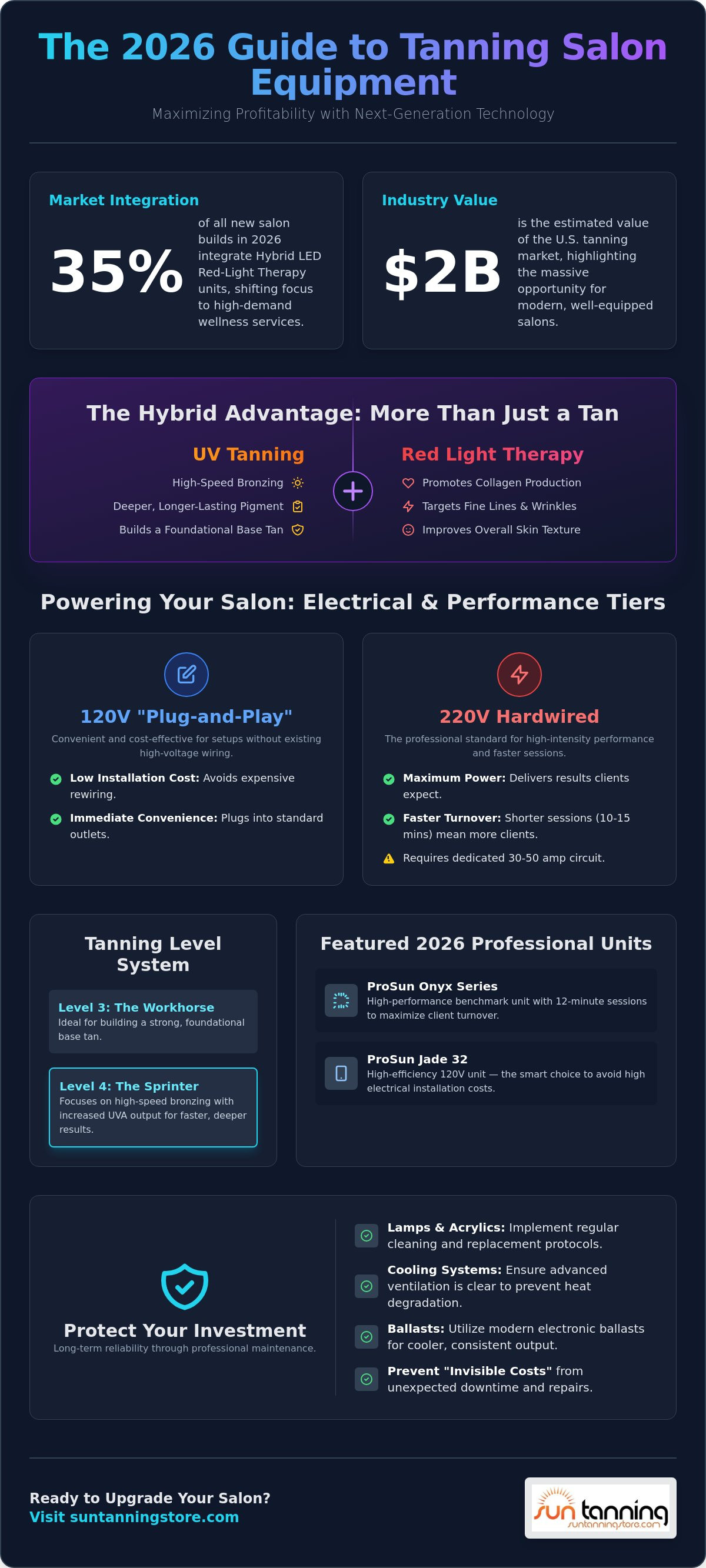
Did you know that as of June 2026, hybrid LED red-light therapy units are integrated into 35% of all new salon builds? This shift proves that modern owners are prioritizing versatile technology to capture a larger share of the $2.0 billion U.S. market. You likely know that keeping your floor current is essential. Still, the prospect of high electrical installation costs and complex maintenance often stalls progress. It's a difficult balance. You need tanning salon equipment that delivers results without becoming a logistical burden.
This guide shows you exactly how to select the most profitable units while avoiding common pitfalls like outdated tech or inefficient power setups. We'll explore how Level 4 hybrid beds and Red Light Therapy can drive higher ticket prices and faster session turnover. You'll also find practical advice on maintaining lamps and acrylics to ensure your investment lasts. We're providing the technical depth and commercial insight required to maximize your ROI and keep your salon ahead of the curve.
Key Takeaways
- Identify how hybrid technology integrating UV and Red Light therapy can shift your business toward high-demand wellness and skin rejuvenation services.
- Evaluate the critical differences between 120v "Plug-and-Play" and 220v hardwired units to minimize electrical installation overhead and optimize performance levels.
- Select a strategic mix of tanning salon equipment, including stand-up booths and lay-down beds, to accommodate hygiene preferences and maximize floor space.
- Compare featured 2026 models like the ProSun Onyx and Jade 32 to find the right balance of session speed and power for your specific clientele.
- Implement professional maintenance protocols for lamps and acrylics to prevent "invisible costs" and ensure the long-term reliability of your investment.
The Evolution of Tanning Salon Equipment in 2026
The tanning industry has undergone a radical transformation over the last few years. It's no longer just about achieving a "base tan" for a summer vacation. Modern tanning salon equipment now serves as a multi-functional wellness hub. Consumers are increasingly demanding skin rejuvenation and anti-aging benefits alongside their UV exposure. This shift toward a holistic wellness approach has forced a design overhaul across the board. Older, power-hungry units are quickly being phased out. They're being replaced by high-efficiency models that help salon owners manage rising energy costs while providing a superior experience. Understanding the history and technology of indoor tanning helps illustrate how far we've come from basic UV lamps to today's sophisticated hybrid systems.
Professional equipment in 2026 generally falls into three core categories. First, traditional tanning beds remain the foundation, though they've been upgraded with better cooling and hybrid lamps. Second, stand-up booths offer a space-saving, hygienic alternative for high-traffic environments. Finally, spray tanning start up kits have become essential for any full-service facility. These kits allow you to capture the sunless tanning market, which now accounts for a significant portion of total industry revenue.
The Rise of Hybrid Tanning Technology
Hybrid units are the strategic choice for 2026. These systems combine traditional UV output with Red Light therapy in a single session. It's a powerful value proposition for your customers. You aren't just selling a tan; you're selling a skin treatment that targets fine lines and promotes collagen production. Because these sessions offer visible improvements in skin texture, salon owners are successfully charging premium rates for hybrid sessions. You can explore the Top Benefits of Hybrid Red Light Tanning Beds to see why this technology is a must-have for modern facilities. It's about maximizing the revenue potential of every square foot in your salon.
Commercial vs. Residential Equipment Standards
Professional environments demand a higher grade of engineering than residential models. While a home unit might run once or twice a day, commercial tanning salon equipment must withstand back-to-back sessions for twelve hours straight. Durability is non-negotiable. High-grade cooling systems are a major differentiator here. Professional beds use advanced internal ventilation to protect the ballasts and lamps from heat-related degradation. We're also seeing a shift toward high-intensity, 10-15 minute sessions. Faster turnover means more clients per hour. It's the most direct path to increasing your daily revenue without expanding your physical footprint.
Technical Specifications: Electrical and Performance Levels
Selecting the right tanning salon equipment requires more than just picking a design that looks good in your lobby. You have to account for the technical infrastructure of your building. The most critical decision is choosing between 120v "Plug-and-Play" units and 220v hardwired commercial systems. While 120v beds offer immediate convenience, 220v systems provide the high-intensity performance that professional clients expect. Behind the scenes, the longevity of your investment depends heavily on ballast technology. Electronic ballasts are now the industry standard. They offer cooler operation and more consistent UV output than older magnetic versions.
Understanding the Tanning Level System
The industry uses a "Level" system to categorize lamp intensity and session times. Level 3 beds are often seen as the workhorses for building a base tan. Level 4 units focus on high-speed bronzing with increased UVA output. High-performance models, like the ProSun Onyx series, serve as the benchmark for these categories. These units often feature 12-minute session times to maximize client turnover. Smart salon owners structure their pricing based on these tiers. They charge a premium for the faster results and deeper pigment associated with higher-level equipment.
Navigating Electrical Logistics
Electrical overhead is frequently the most overlooked expense in a new salon build. A standard 220v commercial tanning bed typically requires a dedicated circuit with a 30-amp or 50-amp breaker, depending on the specific lamp count and cooling capacity. If your facility isn't already wired for high voltage, the cost of adding several 220v lines can be staggering. In these cases, a high-efficiency 120v unit like the ProSun Jade 32 is often the smarter financial choice. It allows you to offer professional-grade services without the need for expensive electrical renovations.
Regardless of the voltage, you must ensure your equipment meets FDA performance standards for sunlamp products to maintain compliance and safety. Fluctuations in your building's power supply can also damage sensitive components. Using buck-boost transformers is a standard industry practice to regulate incoming voltage. This protects your boards and ballasts from premature failure. If you're unsure which power configuration fits your space, you can consult with an equipment specialist to review your floor plan's electrical capacity.
Essential Equipment for a Full-Service Tanning Salon
A successful salon relies on a diversified inventory. Relying solely on traditional UV beds is a strategy of the past. You need a strategic mix of tanning salon equipment that addresses varying customer preferences and physical space constraints. This includes high-intensity lay-down units, vertical booths, and sunless options. While expanding your inventory, it's vital to stay informed on Public health interventions for sunbeds to ensure your operations align with global safety recommendations. Diversity in your floor plan ensures you don't turn away customers who have specific hygiene concerns or time limitations.
Accessories are the lifeblood of your daily operations. You can't maintain a premium reputation with cloudy Tanning Bed Acrylics or aging lamps. Keeping a stock of high-level sanitizers and replacement lamps is a logistical necessity. These components ensure that every session is as effective as the first. Neglecting these "small" details often leads to a visible drop in tanning results, which is the fastest way to lose a recurring client base.
Selecting the Right Mix of Beds and Booths
Efficiency starts with your equipment ratio. For most new builds in 2026, we recommend a 50/50 split between traditional UV beds and modern hybrid units. This balance allows you to serve the cost-conscious customer while upselling the wellness-seeker to a premium hybrid session. Space optimization is another critical factor. Vertical booths allow you to increase session capacity per square foot, as they require a smaller footprint than lay-down models. If you're looking for curated bundles to simplify your startup process, see the Comprehensive Guide to Tanning Salon Equipment Packages for detailed breakdown examples.
Sunless Tanning and Startup Kits
Sunless services provide the highest profit margins in the industry. Because these sessions don't require the same electrical load as a Level 4 bed, your overhead per session is significantly lower. You have two main paths: manual spray guns or automated booths. Manual guns offer a customized, high-touch experience that many clients prefer, while automated booths provide privacy and consistency. To get started, you'll need high-quality professional spray tanning supplies, including pop-up tents, extraction fans, and premium solutions. These startup kits allow you to add a lucrative revenue stream with a relatively low initial investment, making them a staple for any competitive 2026 salon.
Featured Professional Units for 2026
Selecting specific models for your facility requires a focus on operational speed and technological integration. Finding the right tanning salon equipment involves balancing upfront acquisition costs with long-term revenue potential. In 2026, the market has shifted toward units that offer multi-functional benefits, such as the ProSun Onyx 12 Minute Level 4 Hybrid. This model is widely considered the gold standard for high-speed tanning, offering the intensity required for rapid bronzing. For owners looking for economical power, the Solar Storm Commercial Series provides a reliable, budget-conscious alternative that doesn't sacrifice build quality. If your goal is to diversify into dedicated wellness treatments, the ProSun Sundream stands out as a top choice for versatile red light canopy therapy.
Performance benchmarks are no longer just about UV output. Modern buyers prioritize units that minimize downtime and maximize comfort. High-efficiency ballasts and advanced cooling systems are now standard requirements for any commercial-grade investment. These features ensure that your beds can handle a high volume of clients during peak hours without overheating or losing lamp intensity. Investing in recognized brands ensures you have access to the specific technical support and replacement parts necessary to keep your floor running at 100% capacity.
High-Performance Hybrid Models
The Onyx series is engineered for the high-traffic salon. Its advanced internal cooling systems protect the internal components, which is critical for maintaining consistent lamp performance throughout the day. Red Light integration in these hybrid models does more than just enhance the tan. It significantly improves the customer experience by addressing skin texture and rejuvenation during the session. This dual-action approach allows you to market your services as a premium wellness treatment rather than a basic cosmetic service. You can explore the full range of ProSun tanning beds to compare specific feature sets and find the right fit for your client demographic.
Entry-Level and Space-Saving Options
The ProSun Jade 32 is a favorite for salon owners operating in leased spaces or facilities with limited electrical capacity. Because it provides best-in-class 120v hybrid performance, it offers a "no rewiring" benefit that can save you thousands in contractor fees. The compact footprint of these units allows for better space management, enabling you to fit more rooms into a smaller square footage. This increases your total session capacity per hour without requiring a massive facility. These space-saving units are ideal for boutique salons or existing businesses looking to add tanning as a secondary service. You can browse our full inventory of professional beds to see which models align with your current electrical setup.
Maintenance, Longevity, and Protecting Your Investment
The most dangerous expense in your facility is the one you can't see. Lamp degradation is the "Invisible Cost" of running a salon, directly impacting your reputation and repeat business long before a bulb actually burns out. When tanning salon equipment loses its UV intensity, clients stop seeing results, yet your electrical costs remain the same. This leads to a rapid decline in ROI. Protecting your investment requires a disciplined approach to technical upkeep that goes beyond simple surface cleaning. Regular maintenance, which industry data suggests can cost between $300 and $600 per service, is essential for preventing catastrophic component failure.
Operational excellence depends on a structured schedule. Your staff should follow a tiered maintenance protocol to ensure the equipment remains in peak condition:
- Daily: Sanitize acrylics after every session using approved salon-grade cleaners. Check for fan obstruction and ensure all internal cooling systems are active.
- Weekly: Remove the Tanning Bed Acrylics to vacuum dust from the lamps and reflectors. Dust buildup acts as an insulator, increasing heat and shortening the life of your ballasts.
- Monthly: Inspect all electrical connections and check for signs of wear on the gas shocks or hinges. Verify that the session timers are accurate and compliant with local regulations.
Lamp Life and Replacement Strategy
Understanding the difference between "effective life" and "burn life" is critical for profitability. A UV lamp might continue to light up (burn life) for thousands of hours, but its ability to produce a tan (effective life) usually drops significantly after 500 to 800 hours. You must track session hours meticulously to ensure consistent bronzing results. Mixing lamp brands is a mistake; it often leads to uneven tanning results and unnecessary electrical stress on your ballasts. When output drops below 70% of the original intensity, it's time for a full set of Replacement Tanning Lamps to maintain your service standards.
Acrylic Care and Sanitization
Acrylics are the most frequently replaced physical part of a bed, but most damage is entirely preventable. Standard household cleaners containing ammonia or alcohol will chemically react with the material, causing it to become brittle and opaque. This cloudiness blocks UV rays, forcing you to run longer sessions for the same result. The financial impact of replacing acrylics prematurely is significant, often costing hundreds of dollars per sheet. Always use specialized Tanning Lotions and Sanitizers designed specifically for tanning salon equipment surfaces. You can browse tanning bed parts and accessories for specialized cleaning solutions that protect the clarity and flexibility of your equipment's surfaces.
Future-Proof Your Salon with High-Efficiency Technology
Building a profitable facility in 2026 requires a shift toward high-performance hybrid systems and disciplined maintenance. You've seen how the right equipment mix and technical planning can lower your overhead while attracting a wellness-focused clientele. By focusing on Level 4 performance and maintaining your acrylics and lamps, you protect your reputation and your bottom line. Investing in the latest tanning salon equipment is the most direct way to stay ahead of competitors and maximize your daily turnover.
We're proud to be an authorized distributor for ProSun, Solar Storm, and Wolff, offering you the reliability of top-tier manufacturing. Take advantage of our professional benefits, such as free shipping on orders over $49.99 and no sales tax in most states. Our team is ready to help you select the units that fit your specific electrical capacity and business goals. Shop the Full Collection of Professional Salon Equipment to start your upgrade. We look forward to helping your business thrive in this evolving industry.
Frequently Asked Questions
What is the difference between Level 3 and Level 4 tanning beds?
Level 3 beds focus on building a base tan with higher UVB percentages, while Level 4 beds are designed for high-speed bronzing through increased UVA intensity. Level 4 units, such as the ProSun Onyx, typically feature shorter session times of around 12 minutes. This allows for faster client turnover and higher session pricing. Choosing the right level depends on your clientele's goals for pigment depth and time convenience.
Do I need a special electrical setup for a commercial tanning bed?
Most commercial tanning salon equipment requires a dedicated 220v electrical circuit with a 30-amp or 50-amp breaker. Standard household 120v outlets aren't sufficient for high-intensity commercial ballasts and cooling systems. You'll need to consult a licensed electrician to ensure your facility's wiring can handle the specific load requirements of each unit. Using buck-boost transformers is also a standard practice to regulate voltage and protect internal components.
How much space do I need for a professional tanning booth?
A standard professional tanning booth typically requires a footprint of approximately 4 feet by 4 feet, excluding the necessary clearance for the door and ventilation. Because these units are vertical, they're excellent space-savers for salons with limited square footage. You should also account for a private changing area around the unit. Total room size often averages 7 feet by 8 feet to ensure customer comfort and proper airflow.
What are the benefits of a hybrid tanning bed over a traditional one?
Hybrid tanning beds combine traditional UV output with Red Light therapy to provide skin rejuvenation benefits alongside a tan. This dual-action technology targets fine lines and promotes collagen production, which allows you to market the session as a premium wellness service. It's a significant revenue driver in 2026. Customers are often willing to pay a higher ticket price for the added skincare aspect of the session compared to traditional UV-only beds.
How often should I replace the lamps in my tanning salon equipment?
You should replace lamps every 500 to 800 hours of session time to maintain consistent bronzing results. While a lamp might continue to light up for much longer, its effective life for UV output declines significantly after this window. Using a digital hour meter on your tanning salon equipment is the most accurate way to track this. Replacing lamps on schedule prevents client dissatisfaction caused by weak or uneven tanning results.
Can I use a 120v tanning bed in a professional salon environment?
Yes, 120v units like the ProSun Jade 32 are specifically designed for professional environments with limited electrical capacity. These "Plug-and-Play" models don't require expensive rewiring, making them ideal for leased spaces. While they may have slightly longer session times than 220v Level 4 beds, they still provide professional-grade results. They serve as an excellent entry-point for boutiques or salons looking to add tanning services without a massive infrastructure investment.
What equipment is needed to start a spray tanning business?
Starting a spray tanning business requires a high-quality turbine system, a professional spray gun, and a portable extraction fan. You'll also need a pop-up tent to contain overspray and a selection of premium tanning solutions. Many owners opt for Spray Tanning Start Up Kits to ensure all components are compatible from day one. These kits provide high profit margins because they have low electrical requirements and minimal maintenance needs compared to UV beds.
Is financing available for large-scale tanning equipment purchases?
Financing options for large-scale equipment purchases vary based on current market conditions and your business's credit profile. Many salon owners utilize equipment leasing or third-party business loans to manage the initial capital expenditure. It's best to check with specialized industry lenders who understand the depreciation and ROI cycles of professional tanning units. We recommend reviewing your business plan and projected session volume before committing to a specific financing structure.