


Replacement Acrylic Buying Guide: Choosing the Right Shield for Your Tanning Bed
Your tanning bed’s shield is a precision UV filter, not just a physical barrier. If you attempt to swap it for standard hardware-store plexiglass, you'll likely block the very UV rays your lamps are designed to emit. Finding the right replacement acrylic is essential for both tanning efficiency and client safety. Old, yellowed, or cracked sheets don't just look bad; they significantly reduce UV transmission and can lead to dangerous overheating. It's a common issue that leaves many salon owners and home users wondering if their lamps have simply lost their power when the shield is actually the culprit.
You probably realize that a dull, pitted surface is holding your equipment back and compromising the user experience. We agree that equipment maintenance should be straightforward, not a guessing game of brand compatibility and measurements. This guide teaches you how to identify, measure, and select a UV-transmitting replacement that restores factory-level performance. We'll walk through specific model requirements for brands like ProSun and Luxura to ensure you get a guaranteed fit. By the end, you'll know exactly how to maintain the heat resistance and output levels required by international safety standards to keep your tanning environment both effective and secure.
Article at a Glance:
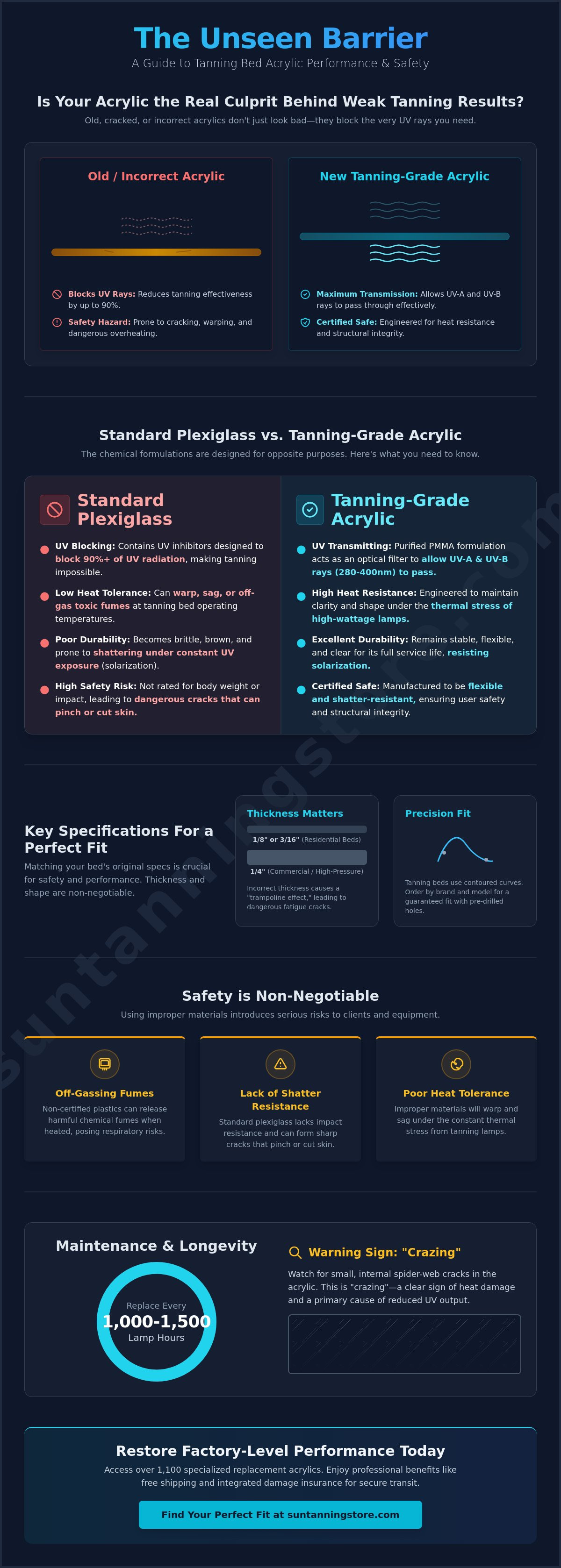
- Material Science: Standard plexiglass is engineered to block UV rays. A specialized replacement acrylic is required to ensure UV-A and UV-B rays reach the user effectively without being filtered out.
- Technical Specifications: Thickness varies by application. Residential beds typically use 1/8 inch or 3/16 inch sheets, while high-pressure commercial models require 1/4 inch heat-resistant material to handle higher operating temperatures.
- Precision Fit: Tanning beds utilize contoured curves rather than flat sheets. Ordering by brand and model ensures pre-drilled holes and the exact radius needed for your specific equipment, preventing installation failures.
- Replacement Cycles: Plan for new acrylic every 1,000 to 1,500 hours of lamp use. Watch for "crazing," which are small internal cracks that signal heat damage and reduced UV output.
- Inventory and Logistics: Access a selection of over 1,100 specialized products. Most orders include professional benefits like free shipping and integrated damage insurance for secure transit.
Understanding Tanning Bed Acrylic vs. Standard Plexiglass
Clear plastic is not always what it seems. Many equipment owners mistakenly believe that standard plexiglass from a local hardware store can serve as a substitute for a professional tanning shield. It can't. Most commercial-grade acrylic is manufactured with UV inhibitors specifically designed to block ultraviolet radiation. This prevents outdoor signs and windows from yellowing, but it renders a tanning bed completely useless. If you install the wrong material, you'll block the very rays your lamps are designed to emit. A professional replacement acrylic is engineered to be invisible to UV light, ensuring maximum transmission for effective tanning results.
The performance gap is staggering. Using non-tanning grade plastic can reduce UV effectiveness by up to 90%. This means your lamps could be brand new, yet the person inside the bed would receive almost no tanning benefit. Since the rise of Indoor tanning as a regulated industry, the technology behind these shields has become increasingly sophisticated to balance output with user protection.
The Science of UV Transmission
Tanning-grade acrylic is a precision-engineered optical filter. While both standard plexiglass and tanning shields are made from polymethyl methacrylate (PMMA), the chemical formulations are opposite. Standard sheets include additives that absorb UV to protect the plastic's molecular structure. Tanning sheets are purified to allow UV-A and UV-B waves, typically in the 280 to 400 nanometer range, to pass through with minimal interference. Without this specific formulation, your replacement acrylic won't perform. Over time, inferior plastics suffer from "solarization." This is a molecular breakdown where constant UV exposure turns the plastic brown and brittle, further choking off the lamp's output and making the sheet prone to shattering.
Safety Risks of Improper Materials
Safety is a non-negotiable factor in a salon environment. Tanning lamps, particularly those in high-wattage commercial beds ranging from 100W to 200W, generate significant thermal energy. Standard industrial plastics aren't rated for these temperatures and may warp or sag under the heat of the canopy or the weight of a user on the bench.
- Off-gassing: Non-certified plastics can release chemical fumes when heated to tanning temperatures, posing potential respiratory risks to the user.
- Shatter-resistance: Tanning acrylic is manufactured to be flexible enough to handle the weight of a person without cracking, yet rigid enough to maintain structural integrity.
- Heat Tolerance: Specialized sheets maintain their shape and clarity under the constant thermal stress of Level 4 and 5 high-pressure systems.
Don't risk the structural failure of your equipment. Standard plexiglass often lacks the impact resistance required for a bench, leading to dangerous internal cracks that can pinch or cut skin. Choosing a certified shield ensures the material remains stable, clear, and safe for the duration of its service life.
Key Specifications: Thickness, Heat Resistance, and UV Ratings
Selecting a replacement acrylic requires more than just confirming UV transmission. You must match the physical specifications of your bed to ensure structural safety and thermal durability. Tanning beds are classified as medical devices, and FDA information on tanning highlights the importance of following manufacturer guidelines to maintain the safety of these units. The thickness and heat rating of your shield are the primary factors in preventing bench failure or canopy warping during high-output sessions.
Structural integrity depends on thickness. A bench acrylic that's too thin will flex excessively. This flex creates a "trampoline effect" that eventually leads to fatigue cracks near the mounting bolts or structural supports. For high-traffic salons, 1/4-inch acrylic is the industry standard for durability. In contrast, canopy acrylics can often be thinner, such as 3/16-inch, because they don't bear weight, but they still must resist the rising heat from the lamps below without sagging.
Comparing Acrylic Thickness Grades
- 3/16-inch: This is the standard for most home units and entry-level commercial beds. It offers a balance of UV clarity and moderate weight support for residential use.
- 1/4-inch: Essential for heavy-duty commercial benches. This thickness provides the rigidity needed to prevent the sheet from "bottoming out" against the lamps under a user's weight.
- Custom thickness: Stick strictly to OEM specifications for beds with unique contours. Deviating from the original thickness can affect the focal point of the UV rays and the fit of the retaining clips.
Heat Tolerance for High-Output Lamps
Commercial beds like the ProSun Onyx 12 Minute Level 4 Hybrid Commercial Tanning Bed use high-output lamps that create significant thermal stress. If your replacement acrylic isn't rated for this specific heat intensity, it will develop "crazing." These are thousands of tiny internal fractures that look like spiderwebs. Crazing scatters UV rays and significantly weakens the material's structural capacity.
Yellowing isn't just an aesthetic issue; it's a sign of molecular degradation. When acrylic reaches its thermal limit, it becomes brittle. You'll notice this first at the edges or near the lamp ends where heat is most concentrated. Proper cooling is vital to prevent this. Ensure your bed's internal fans are clear of dust to preserve the life of your new shield. Explore our full range of tanning bed acrylics to find the exact match for your unit's thickness and heat requirements.
Brand Compatibility: Finding the Right Fit for Your Equipment
Precision is everything. Tanning beds are rarely standard rectangles; they feature specific, contoured curves designed to focus UV energy. Ordering a professional replacement acrylic by brand and model ensures you receive a sheet with the exact radius bends and pre-drilled mounting holes required for your frame. Generic "cut-to-fit" options often lead to jagged edges and stress fractures, which can cause the material to fail under the weight of a user or the heat of the canopy.
Distinguishing between bench and canopy requirements is your first step. Bench acrylics are typically thicker and designed for weight-bearing, while canopy sheets focus on heat resistance and UV clarity. At Sun Tanning Store, we maintain an inventory for over 40 leading brands, ensuring that whether you operate a modern unit or a legacy model, your equipment remains operational and safe. Don't settle for a "close enough" fit when the structural integrity of your bench is at stake.
Supported Manufacturers and Models
We provide specialized shields for major industry players like ProSun, ETS, Sunvision, Heartland, and Montego Bay. High-end units from KBL or Ergoline require precision-molded replacements because their unique shapes are integral to the unit's cooling and UV distribution. This level of accuracy is necessary to comply with the FDA performance standard for sunlamp products, which regulates how these devices must function. We also support legacy owners by stocking acrylic for Dr. Muller and Puretan units, preventing older equipment from becoming obsolete due to lack of parts.
Measuring for a Perfect Fit
Measurement errors are costly. When documenting your current sheet, don't just measure a straight line from one side to the other. You must measure the "arc" length, which is the distance along the curve of the acrylic. Use a flexible tape measure to follow the contour exactly. Also, pay close attention to the "masking," the black or opaque borders printed on the edges. These borders protect the bed's internal components from UV damage and must align perfectly with your lamps. Finally, identify the exact placement of screw holes and notches. If your replacement acrylic doesn't match these points, you risk cracking the material during installation by forcing a fit that isn't there.
Maintenance and Longevity: When to Replace Your Acrylic Sheets
Tanning bed acrylic is a consumable component, not a permanent fixture. While lamps often receive the most attention during maintenance, the shield is equally vital to the system's performance. Typically, a high-quality sheet maintains its optical clarity for 1,000 to 1,500 hours of lamp use. Beyond this threshold, the material's molecular structure begins to degrade, which significantly chokes off UV-A and UV-B transmission. Even with brand new lamps, an aged replacement acrylic acts as a filter that prevents your equipment from reaching its full tanning potential.
Watch for these three primary indicators that your shield has reached the end of its service life:
- Crazing: These thousands of tiny internal fractures look like spiderwebs. They occur when the material is stressed by improper chemicals or excessive heat, and they scatter UV rays instead of letting them pass through.
- Pitting: Small surface indentations occur over time from physical wear. These pits trap tanning lotions and bacteria, making the bed nearly impossible to sanitize properly.
- Clouding: Microscopic scratches and chemical reactions create a hazy or yellowed appearance. This haze blocks the specific nanometer waves required for an effective tan.
Extending the Life of Your Acrylic
Maintenance habits determine how long your investment lasts. You must prioritize using a dedicated tanning bed sanitizer rather than standard household cleaners. Products containing alcohol or ammonia are catastrophic for PMMA; they strip the surface and accelerate the crazing process. Additionally, build-up from non-approved tanning lotions can create a film that bakes onto the surface under high heat. While some technicians suggest polishing as a temporary fix, it often thins the material and can alter its UV-transmitting properties. Replacing the sheet is the only reliable way to guarantee factory-spec performance.
The Performance Cost of Old Acrylic
The math of equipment maintenance is simple. A two-year-old sheet can block more UV radiation than lamps with 800 hours of use. Replacing acrylic is often cheaper than upgrading lamps for better results, providing an immediate boost in efficiency without the high cost of a full lamp swap. For salon owners, this translates directly to higher customer satisfaction and more consistent tan development across all units. If your shields show signs of wear, browse our inventory of tanning bed acrylics to restore your equipment's output today.
Premium Replacement Acrylic Options at Sun Tanning Store
Sun Tanning Store is a national leader in specialized equipment distribution. We maintain an extensive inventory of 1,196 specialized acrylic products, ensuring that you find the exact replacement acrylic for your specific tanning unit. Beyond sheer selection, we prioritize transactional value through a refined logistics process. Most orders include free shipping and integrated damage insurance to mitigate the inherent risks of transporting fragile, large-format materials. Additionally, we don't add sales tax on orders to most states, which maximizes the maintenance budget for salon owners and independent operators alike.
Compatibility is never a guessing game with our catalog. We provide guaranteed fits for professional units like the ProSun Sundream 12V Hybrid Red Light Tanning Canopy and the ProSun Jade 32 120v Hybrid Red Light Tanning Bed. By sourcing from an established distributor, you eliminate the risk of receiving inferior plastics that could compromise your equipment's safety or output.
Why Choose Authorized Distributor Acrylic?
Reliability is built into our supply chain. We provide precision-cut sheets for high-performance models like the ProSun Onyx and Solar Storm series. These aren't generic plastics. Our shields are specifically engineered for high UV-transmission rates (UV-T) that exceed 85 percent, ensuring that the energy from your lamps actually reaches the user. This level of performance is critical for both traditional tanning beds and high-intensity vertical tanning booths. Choosing authorized materials protects your lamps from overheating and ensures your equipment operates within its original design parameters.
Seamless Ordering and Logistics
Shipping large-format acrylic sheets is a significant logistical challenge. We manage this through specialized packaging and carrier partnerships designed for fragile transit. Our website allows you to navigate the collection by brand name, which facilitates quick discovery and reduces the time spent searching for technical specifications. This efficiency is vital for commercial environments where equipment downtime results in lost revenue. If you're ready to restore your equipment's performance and safety, browse the full inventory of replacement tanning bed acrylic here to find the perfect match for your model.
Restore Factory Performance to Your Tanning Bed
Maintaining a high-performance tanning environment requires more than just fresh lamps. As established, your shield acts as a specialized optical filter that must allow maximum UV transmission while withstanding significant thermal stress. Choosing a high-quality replacement acrylic ensures that you avoid the pitfalls of solarization and structural fatigue common in generic plastics. By prioritizing brand-specific compatibility and following a strict replacement schedule every 1,000 to 1,500 hours, you guarantee both the safety and the satisfaction of every user.
Sun Tanning Store serves as an authorized national distributor for ProSun and Wolff, offering specialized expertise and a massive inventory of over 1,100 sheets. We simplify the procurement process by providing free shipping and damage insurance on most orders, along with zero sales tax in most states to keep your operational costs low. Don't let aged, yellowed acrylic compromise your results. Shop 1,100+ Replacement Tanning Bed Acrylic Sheets today to bring your equipment back to its peak efficiency. Your clients will notice the difference in their results immediately.
Frequently Asked Questions
Can I use regular plexiglass from a hardware store for my tanning bed?
No, you cannot use standard hardware store plexiglass because it contains UV inhibitors designed to block ultraviolet radiation. While this prevents yellowing in signs or windows, it will block up to 90 percent of the tanning rays from your lamps. You must use a specialized tanning-grade replacement acrylic that is chemically formulated to allow UV-A and UV-B transmission.
How do I know if my tanning bed acrylic needs to be replaced?
Replace your acrylic every 1,000 to 1,500 hours of lamp use or whenever you notice visible yellowing, clouding, or pitting. If you've installed new lamps but aren't seeing a significant improvement in tanning results, the acrylic is likely filtering out the UV output. Physical signs like deep scratches or "crazing" also indicate the material has reached the end of its functional life.
What is the difference between bench acrylic and canopy acrylic?
Bench acrylic is engineered for weight-bearing and is typically thicker, often 1/4 inch, to prevent structural failure. Canopy acrylic is usually thinner, such as 3/16 inch, because it doesn't need to support weight. Both types are heat-resistant, but they're not interchangeable because their dimensions and mounting hole placements are specific to their position in the bed.
Will new acrylic make my tanning bed feel hotter or tan better?
New acrylic will tan much better by restoring UV transmission rates to factory levels, but it shouldn't make the bed feel hotter. If your bed feels excessively hot, it's usually a sign of failing cooling fans or dust buildup rather than the shield itself. High-quality acrylic ensures that the energy from your lamps reaches the skin efficiently without being absorbed and turned into trapped heat.
How do I measure my tanning bed to ensure the replacement acrylic fits?
Measure the "arc" length by following the curve of the sheet with a flexible tape measure rather than measuring in a straight line. You also need to document the total width and the exact placement of any pre-drilled mounting holes or notches. Providing the specific brand, model, and year of your equipment is the most reliable way to guarantee a perfect fit.
What is "crazing" on tanning bed acrylic and is it dangerous?
Crazing refers to thousands of microscopic internal cracks that look like spiderwebs within the material. While not immediately dangerous, it's a sign of structural fatigue caused by heat stress or the use of improper, alcohol-based cleaners. Crazing scatters UV rays and makes the replacement acrylic brittle, eventually leading to a full break if the sheet isn't replaced.
Does Sun Tanning Store offer acrylic for older or discontinued tanning bed brands?
Yes, we stock specialized shields for over 40 different brands, including legacy and discontinued manufacturers like Dr. Muller and Puretan. Our inventory includes over 1,100 specialized products to ensure that owners of older equipment can still find precision-cut parts. This wide availability prevents older, high-quality beds from becoming obsolete due to a lack of compatible components.
Is shipping insurance included when I order replacement acrylic online?
Yes, we include free shipping damage insurance on most orders to protect your investment during transit. Large-format acrylic sheets are fragile and require specialized handling to prevent cracking or scratching. We take full responsibility for the logistical risks, ensuring that your new shield arrives in perfect condition and ready for immediate installation.