


How Often to Replace Tanning Bed Lamps: The Expert Maintenance Guide
Tanning lamps don't actually burn out; they fade out. This means your equipment might still be glowing while your customers' results are rapidly disappearing. Understanding exactly how often to replace tanning bed lamps is the difference between a thriving salon and a facility plagued by complaints of weak, uneven tans. Most professionals realize that relying on a visual check is a mistake, as UV output begins to degrade long before the filament fails.
It's frustrating to watch your electricity bill climb while your tanning performance drops, especially when you're trying to avoid the cost of replacing bulbs too early. We understand the need for a pragmatic approach to maintenance that prioritizes both lamp lifespan and customer satisfaction. This expert guide will teach you how to implement a precise replacement schedule, interpret the signs of UV degradation, and maximize the efficiency of your new lamps. We will explore the 70% rule used by top-tier facilities and provide a clear timeline for keeping your ProSun or home units operating at peak performance.
Key Takeaways
- Distinguish between a lamp's rated life and its effective tanning life to ensure your equipment delivers consistent UV performance.
- Apply the 70% rule to determine exactly how often to replace tanning bed lamps, preventing the "danger zone" where tanning intensity drops significantly.
- Recognize physical warning signs like end-blackening and customer feedback regarding "weak beds" as indicators of immediate maintenance needs.
- Learn how to protect your investment by managing heat levels and replacing old acrylics that can block up to 30% of available UV light.
- Compare bulk and staggered replacement strategies to find the most cost-effective maintenance path for your specific salon or home unit.
Decoding Tanning Bed Lamp Lifespan: Hours vs. UV Performance
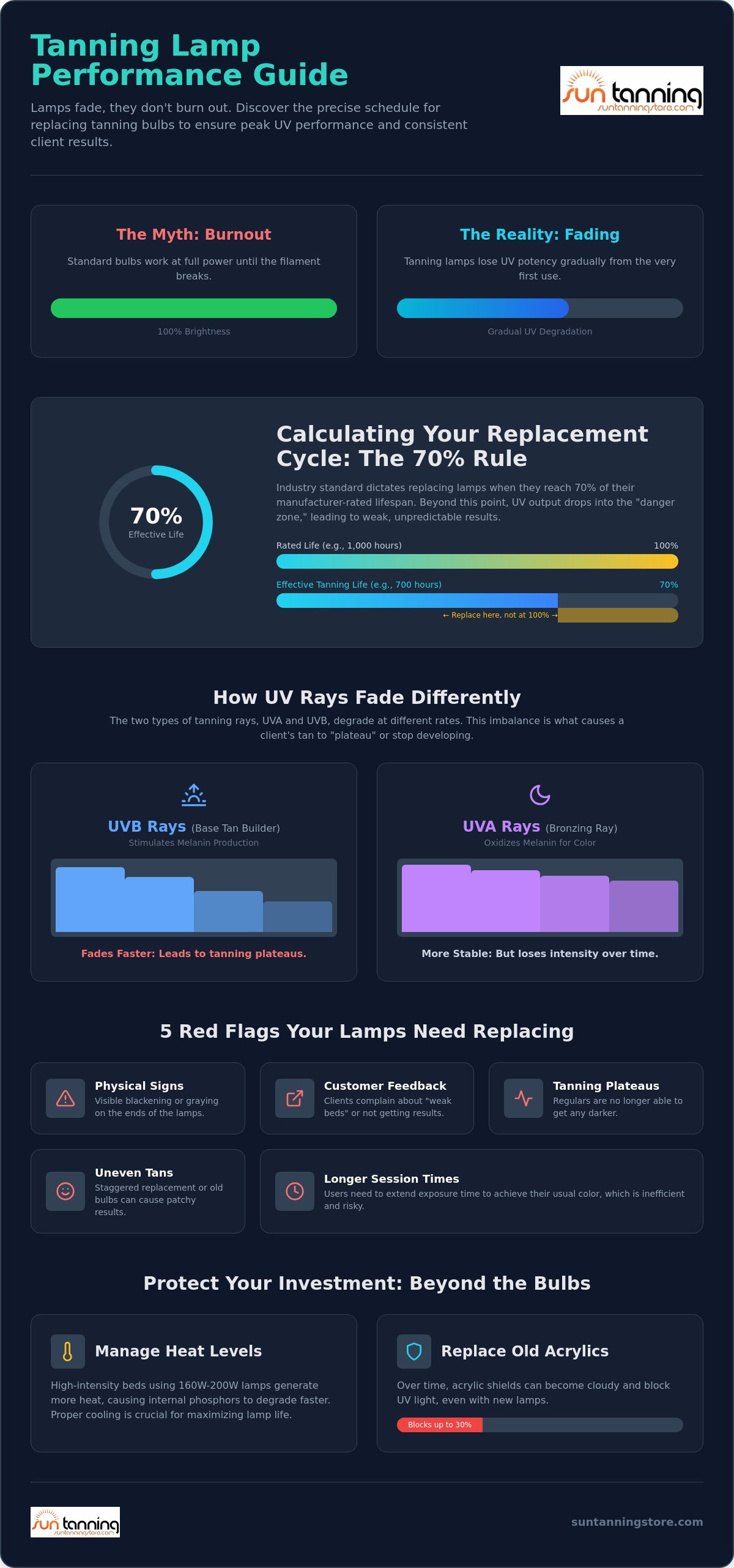
Tanning lamps are unlike standard household bulbs. While a kitchen light stays at full brightness until the filament snaps, tanning lamps begin a slow, invisible decline from the moment they are first energized. This creates a disconnect between the lamp's physical life and its tanning power. Professional salon owners must understand that a bulb that still lights up isn't necessarily a bulb that still performs. Determining how often to replace tanning bed lamps requires looking past the glow and focusing on the UV output levels that actually produce results.
The heart of the lamp is the internal phosphor coating. These chemicals are responsible for converting electrical energy into the specific UVA and UVB wavelengths required for bronzing and base building. Over time, these phosphors degrade due to heat and chemical changes within the glass tube. UV degradation is the gradual loss of phosphor efficiency over time. This process is inevitable, regardless of the lamp brand or the quality of your equipment. For those managing the health risks of indoor tanning, maintaining fresh lamps is essential to ensure sessions remain predictable and effective without forcing users to extend their exposure times to compensate for weak equipment.
Rated Life vs. Effective Performance Life
Manufacturers provide a "rated life" for every lamp, which is a laboratory estimate of how many hours the bulb will physically stay lit before the cathode fails. Standard industry benchmarks typically categorize lamps into 500-hour or 1,000-hour ratings. However, the "effective life" is usually 20% to 30% shorter than this rated figure. A 1,000-hour lamp often loses its ability to deliver professional-grade results long before it hits the four-digit mark. If you wait until the bulb burns out to swap it, you've likely been providing subpar service for hundreds of hours.
How UVA and UVB Rays Fade Differently
The UV spectrum does not fade uniformly. UVB rays, which are responsible for stimulating melanin production and creating the "reddening" effect that builds a base tan, often drop off faster than UVA rays. When UVB levels dip, tanners frequently experience "plateauing." This is the point where a client cannot get any darker, regardless of how many sessions they book. UVA rays are generally more stable, but they eventually lose the intensity required to oxidize the melanin and produce a deep bronze. This shift in the spectrum is why how often to replace tanning bed lamps is a technical decision rather than a visual one. Consistent maintenance ensures that the balance between UVA and UVB remains within the manufacturer's intended specifications for peak performance.
Calculating Your Replacement Cycle: The 70% Rule
Precision maintenance is the only way to protect your business reputation and equipment investment. While manufacturers provide a maximum lifespan rating, the professional industry standard follows the 70% Rule. This formula dictates how often to replace tanning bed lamps by calculating 70% of the manufacturer's rated life. For a standard 1,000-hour lamp, the effective tanning power drops into the danger zone at the 700-hour mark. Beyond this point, the UV output is often too weak to provide the results your clients expect. This can lead to session dissatisfaction and complicates the management of dangers of UV radiation by creating unpredictable exposure levels.
For the most accurate results, professional salons use a digital UV light meter. By taking a baseline reading when lamps are brand new and then checking them monthly, you can swap bulbs based on actual performance data rather than guesswork. If the meter shows a 30% drop from the original reading, it is time for a change. This data-driven approach ensures you aren't throwing away money by replacing bulbs too early or losing customers by keeping them too long.
Setting Up a Maintenance Log
Tracking these hours requires a disciplined approach. Modern equipment, such as the ProSun Onyx or Jade series, features internal digital hour meters accessible through the service menu. If you are using older units, a manual log or a dedicated spreadsheet is essential. You should record the installation date and the meter reading for every bed in your facility. For a comprehensive look at keeping your equipment in top shape, refer to our Ultimate Tanning Bed Maintenance Checklist for 2026.
High-Wattage vs. Low-Wattage Replacement Intervals
Not all beds degrade at the same rate. High-intensity Level 4 units utilizing 160W to 200W lamps generate significantly more heat than standard Level 1 beds. This heat causes the internal phosphors to break down more rapidly, requiring more frequent monitoring. You must also account for the burn-in period. During the first 20 to 50 hours of use, new lamps are exceptionally strong. You may need to temporarily reduce session times for clients during this window to prevent overexposure. Consistency is key across the entire bed. Never mix old and new lamps in the same circuit, as this creates uneven tanning results and can put undue stress on your ballasts. When you're ready to refresh your equipment, you can find a comprehensive inventory of replacement lamps to match your specific bed requirements. Always replace the entire set at once to maintain a uniform UV profile.
5 Red Flags That Your Lamps Have Lost Their Glow
Visual inspections are your first line of defense. While the 70% rule provides a mathematical baseline for how often to replace tanning bed lamps, physical symptoms often manifest before you hit that hour mark. Identifying these red flags early prevents the "weak bed" reputation that can drive clients to competitors. If your canopy looks dim or takes several seconds to achieve full brightness, you are already losing money through subpar performance.
One of the most reliable indicators is the "Mirror Test" using UV-sensitive cards. By placing these cards at various points across the acrylic, you can visualize the UV output in real time. If the card shows deep purple in the center but fades to a light lavender near the ends or in specific "dead spots," your phosphors have degraded unevenly. This inconsistency results in striped or patchy tans, which are impossible for a client to correct with lotions or longer sessions.
Physical Warning Signs of Aging Bulbs
Dark rings at the ends of the lamp, known as "end-blackening," indicate that the cathode is degrading and the internal gas is depleting. While a small amount of graying is normal over time, heavy black soot-like deposits mean the lamp is nearing the end of its effective life. You must also differentiate between a failing lamp and hardware issues. Flickering often signals an overworked starter rather than just a dead bulb; however, a lamp that glows orange at the ends without fully striking is likely exhausted. Consistent maintenance involves checking both the glass and the components that power it.
Client Feedback and Result Inconsistency
Customer complaints are a lagging indicator, but they are incredibly accurate. When tanners start asking for "the good bed" (usually the one with the newest lamps), it is a clear sign that your facility's output is no longer uniform. Handling these complaints requires transparency. You can actually turn this into a marketing opportunity by advertising "New Lamp Weeks" to rebuild trust. Using client feedback as a secondary metric helps you fine-tune how often to replace tanning bed lamps based on the specific traffic patterns of your salon. In a high-volume environment, the psychological impact of seeing a technician install fresh, high-performance lamps builds immediate confidence in your service quality.
- Flickering: Usually indicates a failing starter or a lamp that can no longer hold an arc.
- Slow Starts: Lamps should reach full intensity within seconds; delays suggest gas depletion.
- Inconsistent Brightness: Visual "striping" across the bed suggests some lamps are significantly older than others.
- End-Blackening: Heavy dark rings indicate the cathode is nearly spent.
- Client Plateaus: When regular customers stop seeing color gains, the UV intensity has likely dropped below the effective threshold.
Environmental Factors That Shorten Tanning Lamp Life
Relying strictly on an hour meter to decide how often to replace tanning bed lamps ignores the reality of your equipment's operating environment. External factors like heat, dust, and the condition of your hardware can accelerate phosphor degradation. This means two identical beds in different rooms might require lamp changes at completely different intervals. To maintain peak UV output, you must look beyond the bulb and evaluate the systems that support it.
Grime and chemical residue are silent performance killers. A thin layer of dust on the lamp surface or the internal reflectors acts as a physical UV filter, absorbing energy before it ever reaches the tanner. Similarly, using non-approved, abrasive sanitizers can create a cloudy film on the glass or damage the lamp's protective coating. Regular cleaning with specialized tanning equipment cleaners is non-negotiable for maximizing your investment's lifespan.
The Critical Role of Tanning Bed Acrylics
The acrylic shield is often the most overlooked component in a maintenance schedule. Over time, these shields undergo a process called solarization. This chemical reaction, caused by constant UV exposure, turns the clear material yellow and increasingly opaque. Even if your bulbs are brand new, old Tanning Bed Acrylics can block up to 30% of available UV light. We recommend replacing your acrylics every 2 to 3 years to ensure your lamps' energy isn't being wasted. Additionally, cleaning the internal reflectors during an acrylic swap will help bounce maximum UV back toward the user, significantly improving the bed's tanning efficiency.
Ventilation and Cooling Systems
Heat management is the single most important factor in preventing premature lamp failure. Fluorescent tanning lamps are engineered to operate within a specific temperature window, typically between 100 and 110 degrees Fahrenheit. When ventilation fans are clogged or intake filters are dirty, the bed begins to "heat-soak." This excessive thermal stress causes the internal phosphors to break down rapidly, often resulting in a "swirling" effect inside the glass tube. This visual distortion is a clear sign that the lamp's internal chemistry is failing. You should inspect your cooling system monthly to ensure consistent airflow. If you notice your equipment is running hot, it is time to order high-performance replacement lamps and parts to restore your unit to its factory-spec performance. Maintaining a cool operating environment can extend the effective life of your bulbs by 10% or more.
Strategic Replacement for Salons and Home Units
Deciding how often to replace tanning bed lamps is a technical necessity, but the logistics of the swap require a strategic business mindset. You must choose between a total system overhaul or a gradual, staggered approach. Both methods have merit, depending on your salon's volume and cash flow requirements. For home users, the decision is usually simpler, but the goal remains the same: 100% tanning efficiency. Consistency is the foundation of customer retention, and your replacement strategy directly impacts the quality of the tan you provide.
Hybrid technology adds another layer of complexity to your maintenance schedule. Units like the ProSun Jade 32 120v Hybrid Red Light Tanning Bed utilize both UV and red light phosphors. These different technologies don't always degrade at the same rate. Red light therapy lamps are often rated for longer effective lives than UV lamps, but they still require monitoring to ensure the skin-rejuvenating benefits remain active. If you notice the pinkish hue of the red light lamps shifting toward a duller tone, it's time to test the output, even if the UV bulbs are still performing well.
Bulk vs. Staggered Replacement Strategies
Bulk replacement is the gold standard for high-end commercial facilities. By swapping every lamp in a unit simultaneously, you ensure a uniform UV profile across the entire canopy. This eliminates "cold spots" and guarantees that every client receives the same premium experience. You can even leverage this as a marketing tool. "Fresh Lamp" promotions are highly effective for driving traffic and rebuilding customer trust. For those planning a larger facility upgrade, consult The Comprehensive Guide to Tanning Salon Equipment Packages in 2026 to see how lamp maintenance fits into your long-term operational costs.
Staggered changing is a viable cost-saving strategy for smaller operations or home units. This involves replacing half the lamps, such as every other bulb, at more frequent intervals. While this maintains a decent average UV output, it can result in slight striping if the age gap between bulbs is too wide. Regardless of the method, you must address disposal safety. Tanning lamps contain trace amounts of mercury and must be recycled according to state regulations. Never dispose of these bulbs in standard trash; instead, use a certified hazardous waste recycler to maintain your facility's compliance.
Sourcing High-Quality Replacement Lamps
Sourcing your parts from an authorized tanning equipment distributor is the only way to guarantee compatibility. You must match the lamp wattage exactly to your bed's ballast specifications. Installing a high-wattage lamp into a low-wattage ballast will cause the lamp to underperform and likely fail prematurely. You also need to choose between bronzing lamps (high UVA) and base-building lamps (higher UVB) based on your bed's level. A seasoned distributor can help you navigate these technical specifications to ensure your choice aligns with how often to replace tanning bed lamps for your specific model, keeping your equipment running at peak efficiency for years to come.
Optimize Your Tanning Results with Precision Maintenance
Maintaining peak UV performance requires more than just watching the clock. By implementing the 70% rule and monitoring environmental factors like heat and acrylic clarity, you ensure every session delivers the deep bronze your clients expect. Understanding how often to replace tanning bed lamps is essential for operational efficiency and long-term customer satisfaction. Don't wait for complaints of weak results or visible end-blackening to take action. Proactive maintenance is the most cost-effective way to protect your business reputation and equipment investment.
As an authorized national distributor for ProSun, Sun Tanning Store provides the technical expertise and high-performance parts needed to keep your equipment in factory-spec condition. We offer national shipping on all maintenance parts and expert technical support for salon owners to ensure seamless operations. Whether you're managing a high-volume facility or a personal home unit, we are your reliable bridge to the industry's best technology and logistical advantages.
Shop Premium Replacement Tanning Lamps at Sun Tanning Store to restore your equipment's power today. Keeping your beds at full intensity is a straightforward path to consistent, professional results that keep tanners coming back.
Frequently Asked Questions
How many hours do tanning bed bulbs really last?
Standard tanning lamps are typically rated for 500 to 1,000 hours of physical use. However, their effective tanning life is usually 20% to 30% shorter than that rating. Most professionals find that a 1,000-hour bulb begins to lose significant UV intensity around the 700-hour mark. Knowing how often to replace tanning bed lamps involves tracking these hours to ensure your equipment always delivers professional-grade results.
Can I wait until a tanning bulb burns out to replace it?
No, you should never wait for a burnout to occur. Tanning lamps are technical devices that lose their efficacy long before they physically fail. If you wait until the bulb dies, you've likely been providing subpar tanning results for several months. Professional maintenance requires swapping lamps based on their UV output levels to ensure your clients aren't wasting their time on weak, ineffective sessions.
Do all tanning bed lamps need to be replaced at the same time?
Yes, bulk replacement is the industry standard for maintaining a consistent, high-quality tan. Replacing all lamps at once ensures that the UV intensity is uniform across the entire bed. If you're researching how often to replace tanning bed lamps, remember that mixing old and new bulbs creates uneven results. This "striping" effect can frustrate clients and lead to a decline in repeat business for your salon.
How do I know if my tanning bed needs new bulbs or a new ballast?
If a single bulb won't light, it's usually a dead lamp or a faulty starter. If an entire section of the bed fails to fire, the ballast is likely the problem. You can test this by moving a known working bulb into the dead socket. If the working bulb also fails to light, you have confirmed that the ballast or the internal socket wiring needs replacement.
Does cleaning the bulbs make them last longer?
Cleaning doesn't prolong the internal phosphor life, but it does maximize the UV light that reaches the tanner. Dust, skin oils, and lotion buildup create a physical barrier that absorbs UV energy. By keeping the bulbs clean, you ensure that the lamps are operating at their full potential. This prevents the perception of weak performance and helps you get the most out of your equipment investment.
Are expensive 'bronzing' bulbs worth the extra cost?
Bronzing bulbs are worth the extra cost if you want to provide a premium, high-end tanning experience. These bulbs feature a higher UVA-to-UVB ratio, which is better for darkening existing melanin and producing immediate color. While they require a larger initial investment, they allow you to offer "Level 4" sessions that command higher prices and satisfy experienced tanners looking for faster results.
What happens if I use the wrong wattage lamp in my tanning bed?
Using the wrong wattage can cause immediate hardware damage or even create a fire hazard. Ballasts are engineered to provide a specific electrical load to the lamps. If you install a lamp with a higher wattage than the ballast can handle, the lamp will glow dimly and the ballast will eventually burn out. Always match replacement lamps to the original manufacturer's wattage specifications for safety.
How often should I replace the acrylics along with the lamps?
You should replace your tanning bed acrylics every 2 to 3 years, regardless of how clear they look. Acrylic material undergoes a chemical change called solarization that makes it opaque to UV light over time. Fresh acrylics ensure that the UV output from your new lamps isn't being blocked. This is a critical step in maintaining the overall efficiency and performance of your tanning equipment.